Defense in Depth – Multi-layered security strategies for modern companies
12 November 2024 · 2 min read
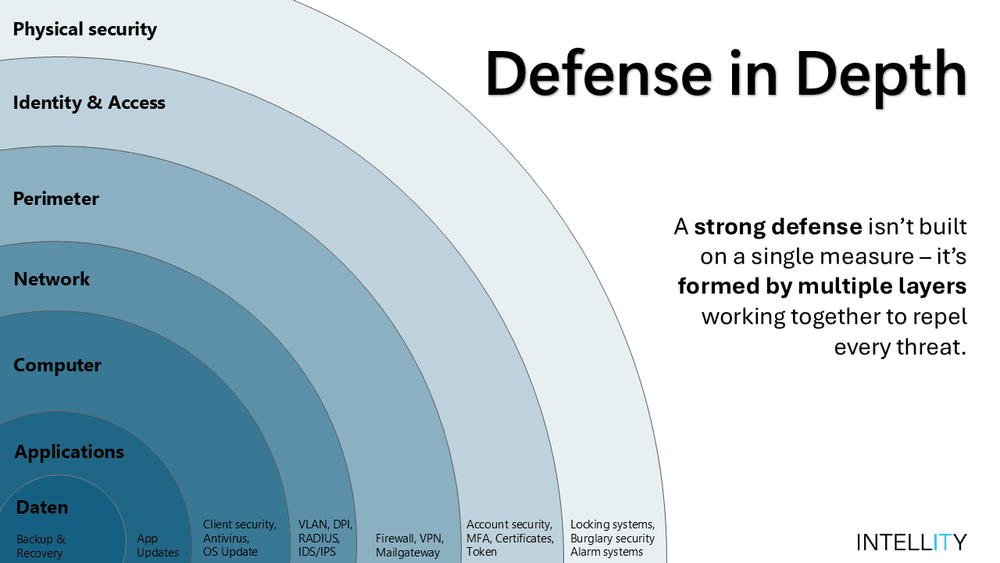
Cyberattacks make headlines every day, and the security of corporate data and systems is more important than ever. Traditional security measures are often no longer sufficient to fend off the diverse and complex threats. This is where the concept of "Defense in Depth" comes into play - a multi-layered security approach that aims to put obstacles in the way of attackers at every level.
What is Defense in Depth?
"Defense in Depth" is a security strategy that implements several independent and complementary security measures. Instead of relying on a single line of defense, this approach relies on multiple layers to minimize attack surfaces and increase resilience against threats.
Comparison with medieval fortifications
Imagine a medieval castle. Not only was it surrounded by a high wall, but it also had a moat, drawbridges, watchtowers and well-positioned defenders. Each of these aspects served to repel intruders or at least slow their progress. "Defense in Depth" works in a similar way in IT security: By implementing various security measures on several levels, it becomes much more difficult for attackers to successfully penetrate a system.
The current threat landscape
Today's cyber threats are diverse and highly complex. From phishing attacks to ransomware to advanced persistent threats (APTs) - the methods used by attackers are becoming increasingly sophisticated. They also often use combinations of different techniques to circumvent security measures.
• Phishing and social engineering: Attackers manipulate employees to obtain access data or confidential information.
• Malware and ransomware: Malware can paralyze systems or encrypt data in order to extort a ransom.
• Zero-day exploits: Unknown vulnerabilities in software are exploited before they can be patched.
Why traditional security measures are no longer sufficient
Individual security products, such as a firewall or an antivirus program, are specialized in warding off certain types of threats. But attackers are constantly finding new ways to bypass these measures. Without a layered approach, companies can quickly become vulnerable.
Benefits of a layered approach
• Reduction of attack surfaces: By having different security measures at different levels, the likelihood of a successful attack is reduced.
• Increased fault tolerance: If one security measure fails, additional layers step in to protect the system.
• Adaptability: A layered approach enables companies to quickly respond to new threats and adapt their security strategy accordingly.
Conclusion
In the modern business world, "defense in depth" is not a luxury, but a necessity. A layered security approach offers comprehensive protection against a variety of threats and ensures that your company is as well prepared as possible against cyberattacks.
In the next article in this series, we will take a closer look at the individual components of "defense in depth" and show how they work together to form a robust security wall.
Interested in a customized security strategy for your company? Contact us and let our experts advise you.


